Cloud RO vs Waterdrop G3P800: Which Reverse Osmosis System Is Better?

Most of us assume our water is clean and safe straight from the faucet. In reality, tap water can contain contaminants like chlorine and fluoride to heavy metals, PFAs, microplastics, and other disinfection byproducts.
Standard pitcher filters or basic under-sink filters can reduce some impurities, but they often fall short of truly purifying your water.
That’s where reverse osmosis (RO) comes in – a filtration process that pushes water through a semi-permeable membrane to remove the majority of dissolved solids, chemicals, and harmful contaminants. The result is water that’s thoroughly purified, safe, and clean.
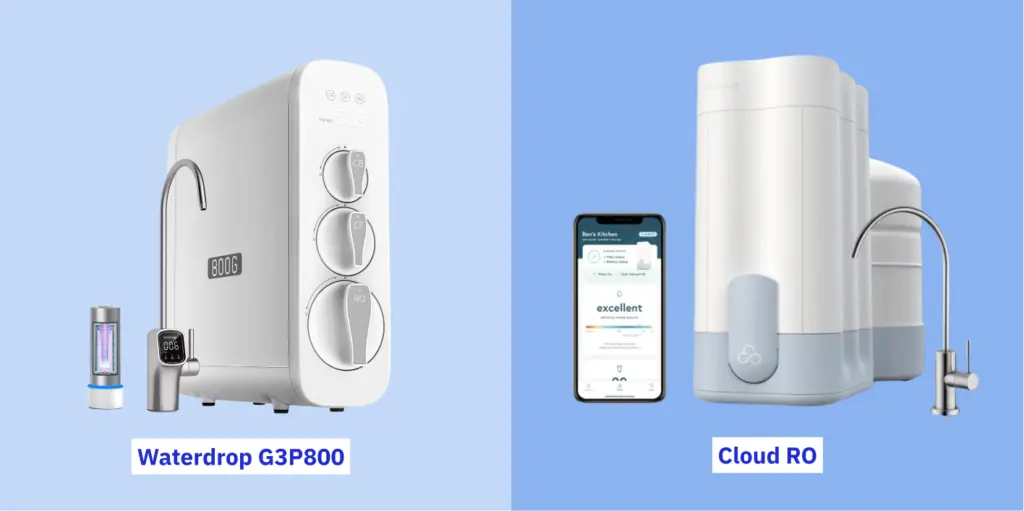
Two of the most talked-about RO water systems are Cloud RO and the Waterdrop G3P800. We tested both to see how they stack up in terms of taste, purification, convenience, and overall performance. Here’s what we found:
Key Similarities
- Both systems use reverse osmosis (RO) filtration to remove contaminants and purify tap water.
- Both are designed as under-sink filtration systems that dispense purified water through a dedicated faucet.
- Both offer high contaminant reduction performance and are designed for households looking for comprehensive water purification.
- Both systems are built with easy maintenance in mind, offering long filter life and straightforward cartridge replacements.
Key Differences
Design
- Cloud RO: Uses a tank-based system with a 2.8-gallon purified water tank that stores filtered water and delivers it quickly as needed.
- Waterdrop G3P800: Uses a tankless design, sending purified water directly to the faucet without first storing it.
Water Quality
- Cloud RO: Includes a remineralization stage that restores beneficial minerals and raises the pH (a measure of its acidity or alkalinity) of purified water.
- Waterdrop G3P800: Uses standard reverse osmosis filtration without a remineralization stage, which can leave the water tasting flat and somewhat stripped.
Contaminant Performance
- Cloud RO: Demonstrated exceptional contaminant removal in independent testing, eliminating fluoride, disinfection byproducts, and 100% of several metals, including aluminum and copper.
- Waterdrop G3P800: real-world contaminant reduction score was strong but slightly lower.
Installation
- Cloud RO: Easy to install and does not require a power outlet. Can be connected to a fridge or icemaker as well as a dedicated faucet.
- Waterdrop G3P800: Equally easy to install, but requires a power outlet under the sink, and can’t be connected to fridge.
Maintenance & Monitoring
- Cloud RO: Includes built-in sensors and app tracking that monitor filter lifespan and system performance so you can see how well the filter is working in real time – simplifying ongoing maintenance if issues arise.
- Waterdrop G3P800: Offers simple filter replacement but lacks monitoring tools.
Cloud Overview
Cloud RO’s system uses a 2.8-gallon storage tank, so purified water is always ready instantly when you turn on the tap. We expected the tank to feel bulky, but it actually fits neatly under the sink. The system also runs on a rechargeable battery pack, meaning it doesn’t need to be plugged into a nearby outlet.
Interestingly, the tank also improves purification. By allowing water more time in contact with the RO membrane, contaminants can be removed more thoroughly. Independent lab tests show strong results: Cloud removes 100% of aluminum, copper, manganese, molybdenum, and strontium, and scores 99/100 for other health-related contaminants.
Because reverse osmosis removes nearly everything from water (including beneficial minerals), Cloud restores essentials like calcium and magnesium afterward. In our testing, this made the water taste noticeably better and more refreshing.
We were initially skeptical about the water-tracking app, but it turned out to be genuinely helpful. It monitors filter life and system performance, so you know exactly when to replace filters, and can contact customer support directly through the app.
Waterdrop Overview
The Waterdrop G3P800 takes a different approach. Instead of using a storage tank, it features a tankless design that produces water on demand. This gives it a slimmer footprint under the sink and an impressively fast flow rate.
But because the system doesn’t store purified water, it relies on a powerful internal pump to force water through its dense reverse osmosis membrane in real time. This means it requires a dedicated electrical outlet.
The system includes a smart faucet with a basic TDS display, along with an internal UV sterilizer designed to reduce microbial growth. Like many standard RO systems, it focuses purely on contaminant removal and does not include a built-in remineralization stage. We found the water tasted noticeably flatter compared to the Cloud RO that restores minerals after filtration.
Waterdrop still performs well in terms of filtration, removing over 99% of contaminants. That said, lab testing suggests it falls slightly short of some tank-based systems. The high-pressure pump pushes water through the membrane very quickly, which reduces contact time and limits filtration.
Our Verdict
Top Under-Sink RO Filters for 2026
✅ Restores beneficial minerals (Alkaline)
✅ Removes 100% of tested heavy metals
✅ Connects to fridge & ice maker
✅ Runs on battery (No outlet needed)
✅ Smart app tracks actual filter life
✅ Full NSF Certification
❌ Tank takes up more space
✅ Slim, tankless design
✅ Fast, on-demand water flow
✅ Internal UV sterilizer
✅ Removes >99% of contaminants
❌ Leaves water tasting “flat” (No minerals)
❌ Requires dedicated under-sink electrical outlet
❌ Cannot connect to fridge
❌ Hidden water waste during flush cycles
Both Cloud RO and the Waterdrop G3P800 are highly capable systems that can dramatically improve tap water quality. They share several core features, including strong contaminant removal, and under-sink installation.
But after comparing both systems in depth, we found that Cloud offers a more complete approach to water quality.
While Waterdrop is certified by IAMPO, Cloud has full NSF certification – the most widely recognized and trusted standard for independent testing of water treatment systems, covering performance, material safety, and structural integrity.
By restoring essential minerals after filtration, Cloud delivers noticeably better-tasting water – a step most standard RO systems leave out. The built-in storage tank also provides consistent pressure and immediate access to purified water without relying entirely on real-time filtration. And the ability to hook it up to the fridge and ice maker is a major plus.
Cloud maintains an efficient 1:1 water waste ratio. Waterdrop claims a 2:1 ratio, but this doesn’t account for the dedicated flushing cycles running in the background. Real-world testing and reviewer feedback indicate its actual waste ratio is worse than Cloud’s, making the claim somewhat misleading.
We also appreciated being able to monitor system performance and filter life through the companion app. Combined with easy installation and Cloud’s efficient water usage, it clearly stands out as the more well-rounded option in our testing.
