

My room sounded great about four hours before I could stand to sit in it. Six grey panels, two corner traps, a rug picked for absorption rather than looks. The boxiness disappeared. So did any evidence that a person with taste lived there.
Anyone who has treated a spare bedroom knows the feeling. You spend real money to get a room to behave, then you stop hanging anything because you have no idea which decision quietly undoes what you just paid for. So the walls stay bare, and you spend five hours a night inside a beige cube with a microphone in it.
Home studio wall decor is not the problem. Hanging the wrong object in the wrong square foot is. The gap between those two comes down to three questions: what the thing is made of, where it sits relative to your speakers, and whether it is plugged in.
What Actually Changes the Way a Room Sounds
Acoustic treatment does two jobs. Absorption panels soak up energy so it stops ricocheting between parallel walls, and bass traps sit in the corners handling low frequencies, which are the stubborn, expensive part of any small room.
Size decides whether an object gets a vote. Sound moves through air at roughly 1,130 feet per second, so a 1,000 Hz tone is a little over a foot long and a 60 Hz bass note stretches to almost 19 feet. An object only reflects frequencies whose wavelength is near its own size or smaller. So a two-foot sign on your wall has no opinion whatsoever about bass. It can bounce upper mids and treble, and only if it lands somewhere, those reflections reach you.
Better news than most people expect. Your panels are doing the heavy lifting, and decor only causes trouble in two situations: when it covers treatment, and when it sits in one of about five specific spots.
The Mirror Trick That Shows You Where Nothing Should Hang
First reflection points are where sound from your speakers hits a surface and arrives at your ears a few milliseconds after the direct sound, usually somewhere in the 5 to 15 millisecond window. Your brain cannot separate the two that are close together, so it blends them. You get a smeared stereo image and a low end that shifts depending on how you are sitting.
Finding those spots takes five minutes and a hand mirror.
- Sit where you normally work, head at its usual height.
- Have someone slide a mirror flat along the left wall at ear height.
- Anywhere you can see a speaker’s face in that mirror, mark it.
- Repeat on the right wall, then along the ceiling above the desk.
- Check the desk surface too, since that one fires straight up into your face and smears the 1 kHz to 4 kHz range where most vocals live.
In a lot of rooms, the side wall points land roughly a third of the way between the monitors and the back wall. Those spots belong to absorption, permanently, and the panel needs to cover a zone rather than the single dot the mirror found. Everything else is fair game.
That usually leaves the rear wall, the wall above the monitors, and most of the space above head height, which is a far more usable wall than the average treated room ever puts to work.
Home Studio Wall Decor That Works With Your Acoustic Treatment
The safest things to hang are soft, or broken up, or small enough and high enough that the reflection they create never arrives at your ears. Slat wood panels scatter mids and highs across several directions instead of returning them as one sheet, which is why they show up behind so many desks.

A packed bookshelf breaks reflections up in a rougher way, though nobody should mistake random book depths for a designed diffuser. Fabric-wrapped canvas is close to acoustically invisible. A rug or textile hanging adds some absorption, just not at the frequencies that cause real headaches.
Then there is the category that appears in nearly every studio photo online. Light. A name or a logo on the front wall above the monitors gives a room a center of gravity without adding one object at ear height. That is why custom neon signs keep turning up in home setups that would otherwise look like gear warehouses. The piece is flat, weighs very little, mounts through a thin acrylic backing with a few screws or standoffs, and sits well above the plane where reflections matter.
One honest caveat. An acrylic backing is a hard, flat surface, the same as a window. It stays out of trouble because of size and position, not because of what it is made of. Put that same sign on a side wall at ear height, right on a reflection point, and you have built yourself a small problem.
Framed Glass Is Riskier Than a Lit Sign
The decor most likely to change your monitoring is the stuff nobody suspects, because it looks like normal adult wall art.
- Anything behind glass, hung at ear height on a side wall. A framed poster or an award plaque is a mirror for high frequencies.
- An actual mirror facing the speakers, which is the single worst object you can own in a small room.
- Guitars hung near the recording position. Open strings ring in sympathy with whatever plays back, and it turns up on quiet takes. A fret wrap or a hair tie around the strings at the nut kills it in two seconds.
- Big sheets of glossy laminate or metal, which behave like glass with an extra ring.
None of this means you cannot own a framed record. It means you hang it on the rear wall behind you rather than on the wall your left speaker is firing at.
While we are naming names: the thin foam tiles sold as studio treatment barely touch anything below about 2 kHz. They are decor with a costume on.
Light Does More for a Studio Than One More Panel
Once a room stops sounding harsh, the next thing that shortens sessions is your eyes. A bright screen in a dark room leaves your pupils stuck between the display telling them to close and the black wall behind it telling them to open, and that tug of war is the low-grade headache people usually blame on the mix.
Light placed behind or beside the screen closes the gap. Studios have done this for years with lamps and LED strips, and a lit sign on the front wall does the same job while also being something worth looking at. Keep it dimmer than the display, somewhere around a tenth to a fifth of screen brightness, and aim the glow at the wall rather than at your face. Brighter than that and it starts competing with what you are watching.
On camera, the same fixture earns its place in a different way. Color on the wall behind you separates you from the background, which is the difference between a shot that looks composed and one that looks like a webcam pointed at drywall. Keep the saturated color off your face, though. A strong red or blue landing on skin sends white balance somewhere you will spend twenty minutes correcting.
The shade matters for the room as much as the camera, since different colors read differently in a small space and can change the mood of a session at 2 a.m. Warm amber and soft white sit quietly in the background. Deep blue and green feel cooler and tend to hold up better on video.
The Part That Actually Buzzes, and How to Test It
The acoustic worry is mostly overblown. The electrical one is real, and almost nobody brings it up.
Anything with a power supply near your signal chain can push noise into a recording. Single-coil pickups are the usual casualty, since a coil of wire wrapped around magnets is an antenna for whatever is radiating nearby. Dimmers are the worst offenders. Switch-mode adapters, phone chargers, and long unbalanced cables running past a power brick come next.
Testing this costs you thirty seconds.
- Arm a track at your normal recording gain and listen on headphones.
- Switch the sign off, then on, then off again.
- Move the power adapter a few feet away from your interface and cables, then listen again.
- If you’re using a guitar, rotate your body while playing. Noise that changes with the angle you are standing at is radiated interference, not your amp.
Two notes on hardware. Old glass tube signs run on a high-voltage transformer whose laminations vibrate, which is where the movie buzz comes from. It is charming in a bar and much less charming in a vocal booth.
LED versions run on a low-voltage adapter and stay quiet, with one exception worth knowing: pair one with a dimmer its driver wasn’t designed for, and you can get a faint hum from an otherwise silent sign. Either way, keep the adapter on a different outlet from your interface where you can, and route its cable away from your audio runs.
When the Studio Is Also Where Everyone Hangs Out
Plenty of these rooms are not only studios. A basement mixes records on a Tuesday and holds a couch, a fridge, and four people on a Saturday, and the decor has to survive both jobs. That is where the bare-walls plan falls apart, since a room full of grey rectangles is fine to work in and grim to sit in with company.
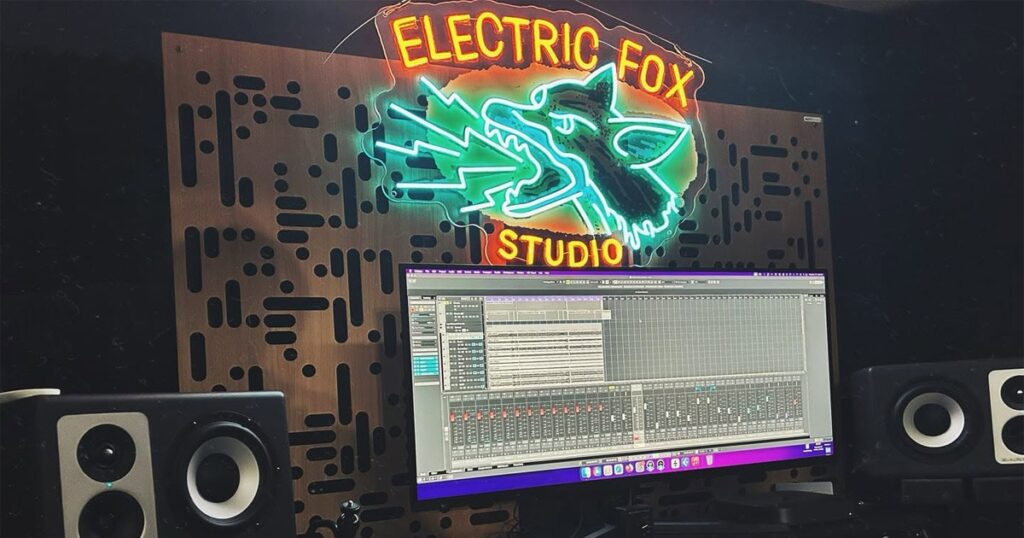
Same principle, applied twice. Keep absorption where it earns its keep, meaning the reflection points and the corners, then let the rest of the wall carry the personality. The way people style a basement hangout is worth stealing from here, because those rooms already solved the problem of making a functional space feel like somewhere you would choose to be.
It also explains a pattern worth noticing in studio photos. A lot of home rooms end up with a name on the wall, and the name almost always goes up after the treatment, not before. Something shifts when a space stops being the spare bedroom with a mic in it. The panels are what make the room work. The wall above the monitors is what makes it yours.