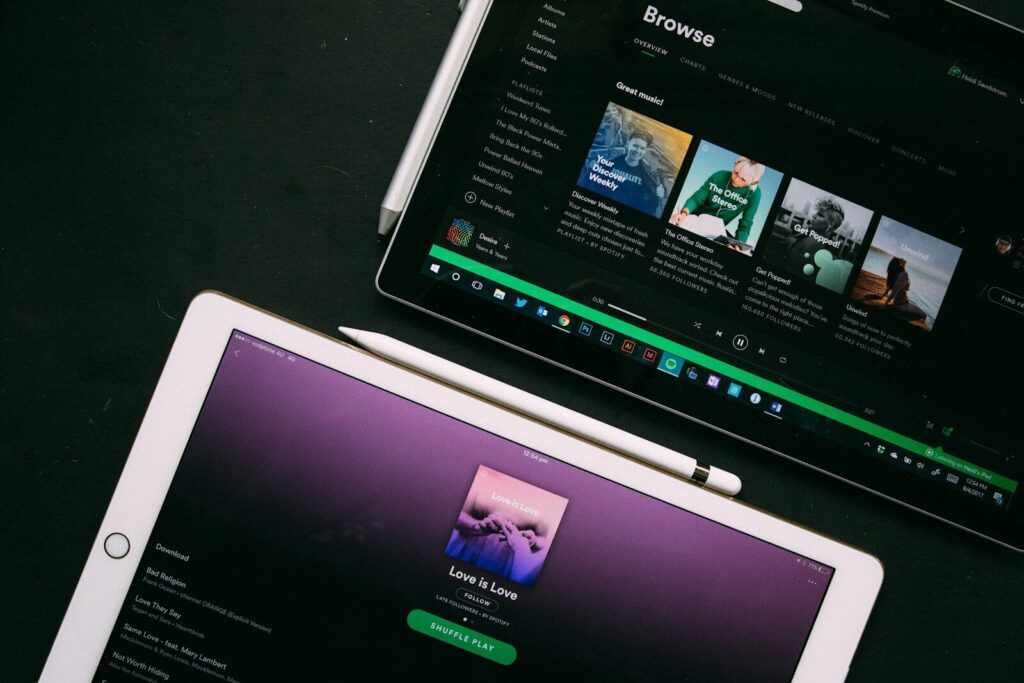
Uploading a song takes ten minutes. Getting to 1,000 streams takes a plan, and Spotify’s rulebook is why. Since April 2024, a track doesn’t count toward royalties until it has logged 1,000 streams in 12 months.
The crowd is huge and still growing. Luminate’s CEO told Billboard in September that close to 150,000 tracks now reach streaming platforms every day. Its year-end report found that 88% of the tracks on streaming services got fewer than 1,000 streams in 2025.
The Payout Line Comes First, Daily Streams Come Later
Spotify’s numbers show how steep the climb is. The artist ranked 100,000th by earnings made more than $7,300 in 2025. Run that through an estimated $0.0035 a play, and it’s about 2 million streams, or 5,500 a day. Spotify doesn’t give out a per-stream rate, so the math is rough.
Against that, 1,000 streams is roughly 0.05% of the distance. Crossing the line gets a track counted and nothing more. The longer climb favors artists who keep releasing. In fact, the same data shows that more than 90% of DIY royalties in 2025 went to artists who had been releasing for more than a year. So plan on a second release before the first one peaks.
The moves below go after the payout line alone. Each fits in an hour with a phone, a spreadsheet, and Spotify for Artists access. The two paid-promotion moves wait until a track passes 1,000 streams.
Break 1,000 Streams Into a Weekly Target
Twelve months is too long to manage, so cut it up. Spread over a year, 1,000 streams is about 19 a week. Packed into the first four weeks, it’s about 250. Use the 250, because after a month you know if the plan works, and after a year you’re still guessing.
Released before? Open Spotify for Artists and look at your last track’s first 28 days. That’s your baseline. If it’s under 1,000, 250 a week is your target. If it’s higher, aim to beat it.
Then put the number in a spreadsheet you’ll check every Monday. In the next hour, open Google Sheets, which is free, and make three columns for release date, weekly target, and review date. For a November 20 release at 250 a week, the review date is December 18, four weeks in.
Count Back From the Pitch Deadline
Start from the pitch deadline and work backward. Popdust’s guide to fast music distribution notes that Spotify needs five business days to get a new release live. Spotify’s own rules add the other half. A pitch submitted at least seven days before release puts the song in your followers’ Release Radar playlists, and you can pitch only one song at a time.
Again, take a November 20 release. Pitch by November 13. Upload by about November 6, a Friday, so the five business days run out on the day the pitch goes in. Both dates go in your calendar tonight.
Spotify takes one pitch at a time, and the next one opens only after the first song is live. Planning a second release? Put it at least seven days after the first, because the pitch itself needs seven days of lead time.
Write the Pitch and the Pre-Save Ask
The pitch goes to Spotify’s editors and runs three sentences. Two cover the song, and one covers you, with a credit that backs you up.
Take Ana, a folk artist from Leeds. Her pitch reads, “Warm indie-folk about leaving a flat in Leeds, built on one acoustic guitar and a drum loop. Written and produced by Ana, whose last single was playlisted by two local curators.”
Friends and fans get a different message. The pre-save ask is one line, “My single drops November 20. Would you pre-save it? Link here.” When the link works, DM your first 20 names one by one. A group post is easy to ignore.
Film One Hook Three Ways
Which 15 seconds? Let a friend decide. Hand over your headphones, press play, and watch their face. The clip begins just before it changes.
Then make three versions in one sitting:
- One is you singing to camera (A),
- One puts the lyric on screen over a simple visual (B),
- One is a rough live fragment (C).
Post them in that order, one a day.
For B you can skip the camera. An AI music video maker such as Freebeat will build a lyric video from the track. Its free tier is capped at 30 seconds, watermarked and limited to non-commercial use.
Post all three at the same hour of the day. After day 3, count saves wherever they’re reported. YouTube Shorts doesn’t report them, so skip it in the count. The most-saved take is your clip.
Set the Rules, Then Hand Off the Reporting
Write the rules before you log a single number, so a bad week can’t talk you out of them. Swap a clip that moves nothing in week one. Change it again if week-two streams miss your target. Past 1,000 streams within four weeks? Payout line cleared.
Then pick a Monday and log four numbers, which are streams, saves, new listeners and top city. Skip a week and the comparison breaks, so keep the same day.
Once the routine runs, the log is an easy chore to hand off. Some artists bring in an online marketing company for it, since it doesn’t need the artist’s voice. The clips, the fan replies and the call on which clip to repost stay with the artist, so sort your tasks into those that need you and those that don’t. The second pile goes to providers in the last section.
Message Nine Local Accounts in Your Top Cities
Open Spotify for Artists, go to Audience and read your top cities. If there’s no data yet, use your hometown, the city of your last gig or wherever a collaborator lives.
You want three accounts per city that already post music like yours. A venue that books your genre counts. A community radio show with a submission form counts too.
Send all nine the same three lines. “Hi Priya, I’m Ana, a folk artist from Leeds. Listeners in Manchester are already streaming my new single, and here is the link plus a 20-second clip. It would suit your Thursday show.” Then log who replies, and from which city.
Compare Promotion Costs With What a Stream Pays
At $0.0035 a play, 1,000 streams is worth about $3.50. That means a $300 promotion needs around 86,000 streams to pay for itself, so saves and ticket sales are the numbers to watch.
That said, ads have a place. After 1,000 streams, $20 behind the winning clip, aimed at the cities that already stream you, makes a fair test. Compare saves per listener with your organic average. If the ads beat it, add budget, and if they don’t, change the clip.
Until then, spend nothing. Decide the most you’d pay for one new listener who saves the track.
What Playlist Pitching Costs and When to Pay
Playlist pitching is worth pricing out before you spend money on promotion. Groover charges about $1.07 per credit and returns credits if feedback doesn’t arrive within seven days. SubmitHub costs roughly $3 per credit, while PlaylistPush starts at $285 for a managed Spotify campaign.
Email two services with your release date and ask for a quote on one specific task from your second list. Find out what’s included, and walk away from anyone who guarantees playlist placements.
Don’t commit yet. Hold off on paid pitching until a track passes 1,000 streams, and one clip starts bringing in listeners. Eighty-eight cents. That’s what 250 streams bring in at an estimated $0.0035 a play, and it doesn’t cover one Groover credit. When both are true, pull the quotes back out and see if paid pitching makes sense.