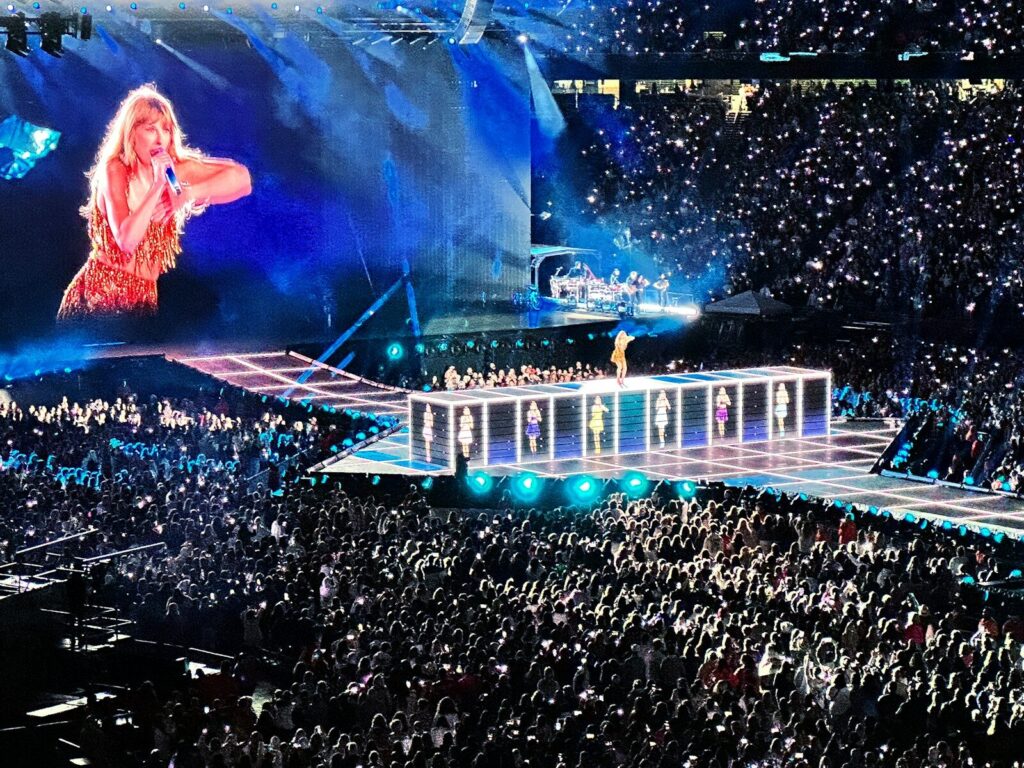
The Eras Tour may have come and gone, but its impact on pop culture, music, and the economy will not be forgotten for decades. According to Billboard, pop star Taylor Swift’s sold-out world tour grossed an estimated $2.2 billion, more than any concert tour throughout history.
Every city the toured touched benefited from the many eras of Swift—from the whimsical purples of “Speak Now” and tie-dye of “Lover” to the cottage-core vibes of “Folklore” and winter plaids of “Evermore.” The hotels, restaurants, and entertainment venues that leaned into the spectacle with themed décor, menus, and events were heavily rewarded. It’s estimated by QuestionPro that Swifties brought in $5 billion in consumer spending in the United States alone. The Federal Reserve even mentioned Swift by name in their 2023 Beige Book.
Taylor Swift has become a phenomenon worth studying in multiple fields. Somewhere in the middle of all the homemade sequined bodysuits and friendship bracelets, a very serious business story was playing out—one that has takeaways for anyone running a company, practice, or storefront.
This business strategy didn’t start with the Eras Tour, though. With a career spanning two decades, let’s look back at Taylor Swift’s strategic and brilliant business playbook.
Lesson One: Own What’s Yours
In 2019, Scooter Braun’s Ithaca Holdings purchased Big Machine Records, the Nashville-based record label that Swift had been signed with for most of her career. With that purchase came the ownership of the masters—aka the rights—for Swift’s first six albums. If she wanted to perform one of her own songs live or license out a single for a movie, she would need to ask permission.
According to Berkeley Technology Law Journal, there are two different types of copyright when it comes to songs: the musical compositions (music and lyrics) and the sound recordings—the so-called “masters” that Braun purchased. Since Taylor wrote her own music and lyrics, she owned that copyright but not the master recordings. Publicly devastated by the knowledge that someone else owned her life’s work, she initiated a methodical, long-game strategy.
One by one, she re-recorded the albums she legally could. By creating new sound recordings she personally owned—deemed “Taylor’s Version”— she could control how these were used. Slowly, she eroded the value of the original masters, then earned enough money from the Eras Tour success to buy them back from Shamrock Capital in May 2025.
The business lesson: understand the value of what you’ve built. Don’t underestimate the assets that you already possess—your brand, customer relationships, data, and processes. Protect your claim to them, because one day, someone might be willing to pay millions to own what you’ve created.
Lesson Two: Make Your Customers Feel Like Insiders
Part of the magic of being a Swiftie, the name fans have given themselves, is feeling like you’re in on a secret that no one else knows. That’s because Swift has been curating an insider fan experience for decades.
Early in her career, she began hiding easter eggs in the lyric booklets that accompanied each album. For example, the hidden message for “Hey Stephen” off the Fearless album read “LOVE AND THEFT”—the name of a band she’d toured with, whose member Stephen inspired the song. Case solved! Over the years, the easter eggs evolved to include hints in music videos and press appearances about what album she might re-record next.
Other hallmarks of the Swiftie experience: intimate secret sessions at her home before album releases, surprise Christmas presents and personally liking and commenting on fan posts on Tumblr and TikTok. To make her re-recordings appealing for fans who already owned the originals, Swift added “From the Vault” tracks, songs that had been cut from the original albums.
The result was a community that jumped at the opportunity to support their favorite artist when she needed them. For business owners, this is a masterclass in customer experience. Loyalty isn’t built through discounts, but rather making customers feel seen, included, and in on the secret.
Lesson Three: When You Can’t Remove the Barrier, Build a New Door
When the Eras Tour presale crashed Ticketmaster’s servers in 2022, millions of fans were locked out. Tickets resold for thousands of dollars, and fans who had waited years for Swift to break her touring hiatus were left heartbroken.
With no control over Ticketmaster’s operations, Swift focused on what she could control. Upon completing the initial U.S. leg of the tour, she released the Eras Tour concert film in theaters at standard movie ticket prices. Playing in theaters across more than 100 countries, it grossed over $261 million globally, becoming the highest-grossing concert film of all time. Then, it landed on Disney+, where millions of fans who never made it into the stadium got to experience the Eras Tour from their living rooms.
Swift built a new door for everyone priced out of the live experience. This is one of the most transferrable lessons in the Swiftonomics playbook, applying directly to any service-based business. When price, geography, or logistics keep some of your loyal customer base from saying yes, the move isn’t to shrug it off and say “next time!” It’s time to create a new path. For medical practices, dental offices, med spas, and veterinary clinics, offering flexible payment options to customers can be that second door. It doesn’t change what you offer. It just removes the barrier to someone saying “yes!”
The Bottom Line
Swiftonomics isn’t magic, glitter, sequins, or even friendship bracelets. It’s an intentional strategy built album by album, tour by tour, and decision by decision over two decades. Taylor Swift knows what she’s worth, and now, she owns every note.
She knows who her customers are, and she rewards their loyalty and passion with heaps and bounds. And when the circumstances shift, she knows how to adapt—swiftly, you might say.
Most importantly, she always makes sure that there’s a way for every fan to be a part of the magical Swiftie experience. That’s good business, and any owner willing to study her playbook might be surprised by how much of it translates beyond music and arenas.