
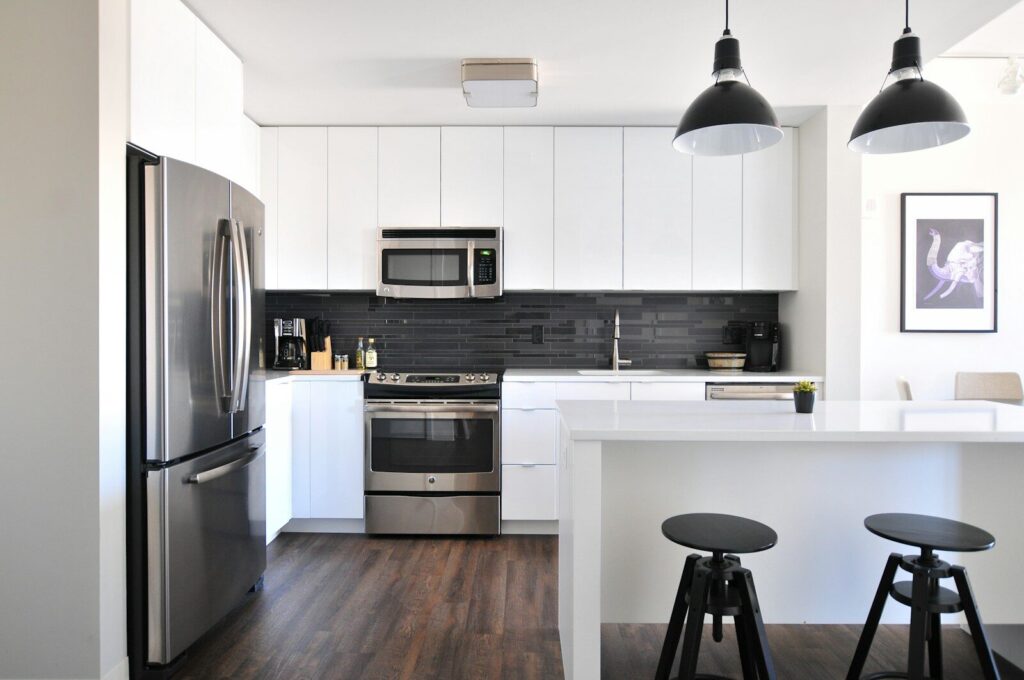
Electrical access was once treated as a fixed utility rather than an element of interior design. Contractors placed receptacles where codes, framing conditions, and convention suggested they should go, while designers worked around the resulting wall plates and cords. That approach remains practical in many rooms, but it becomes less satisfactory as kitchens, offices, and multipurpose spaces grow more visually refined. Large uninterrupted surfaces now carry significant design value, particularly where stone countertops, custom cabinetry, architectural millwork, and carefully selected finishes dominate the view. A conventional outlet can interrupt those surfaces even when it performs its technical function perfectly. Hidden power access attempts to resolve that tension by making electricity readily available when it is needed and visually secondary when it is not.
The change reflects something larger than a preference for cleaner countertops. Modern rooms contain more electrical equipment, yet designers increasingly want fewer permanent signs of that equipment. A kitchen island may serve as a food-preparation zone in the morning, a homework station in the afternoon, and a gathering place in the evening. A conference table may host laptops during a meeting and return to a clean presentation surface after everyone leaves. In both settings, constant access to electricity matters, but constant visual exposure of receptacles does not necessarily add value. Retractable and concealed electrical products address that contradiction by allowing the infrastructure to respond to the way a space is actually being used.
Lew Electric fits into this shift because hidden electrical access turns an ordinary building component into a piece of functional hardware. The central idea is not that an outlet should become decorative for its own sake. Rather, the outlet should occupy the visual field only to the degree required by the user. When concealed, the device can preserve the continuity of a surface, while deployment makes the electrical connection immediately accessible. That simple change affects how architects, interior designers, builders, and homeowners think about power placement. Electricity becomes less of a fixed interruption and more of an on-demand service embedded within the architecture.
When Electrical Hardware Becomes Part of the Interior
Once an outlet moves onto a countertop or work surface, its appearance becomes harder to ignore. A wall receptacle can often disappear into a backsplash, but an electrical device installed in stone, wood, or engineered material occupies a more prominent position. Its diameter, profile, finish, and relationship to nearby fixtures begin to matter in the same way that cabinet pulls and faucets matter. A poorly coordinated device can look like equipment that was added after the design was complete. A well-integrated one can appear to belong to the original architectural plan. This is why hidden power access should be selected as both electrical equipment and visible hardware.
Finish selection is particularly important because modern interiors often rely on repeated material cues. Brass cabinet hardware, dark plumbing fixtures, stainless appliances, or polished metal accents can establish a visual language across a room. A countertop power device introduces another piece of metal into that composition, even if only its top remains visible while retracted. Designers therefore have to consider how that exposed surface relates to faucets, lighting, appliance trim, and cabinet hardware. Exact matching is not always necessary, and excessive matching can make a room feel overly coordinated. What matters is that the electrical component looks deliberate rather than accidental.
Once the visual requirements are defined, the design process moves from theory to specification. Designers and homeowners need to compare actual products by finish, dimensions, installation method, electrical protection, and the amount of space required beneath the work surface. Looking at these devices within a broader electrical catalog can be useful because it places decorative considerations alongside the practical components needed to complete an installation. BuyRite Electric, an online source for lighting, electrical supplies, and tools, is one example of a retailer where these factors can be compared in context. Its collection of design-forward Lew Electric power solutions shows how concealed access can take different forms depending on the surface, finish, and intended use of the space. Within that collection, the Lew Electric PUR20GD-B Round Kitchen Pop Up Outlet, GFCI, Brass offers a more specific example, pairing a brass finish with GFCI protection in a format designed to keep power accessible without allowing the receptacle to dominate the countertop. Looking at these considerations together encourages electrical hardware to be specified as part of the interior from the beginning, rather than added after the major design decisions have already been made.
Hidden Power Has to Work Better, Not Merely Look Better
Concealment has little value if accessing the outlet becomes inconvenient. A successful hidden-power system has to deploy naturally, remain stable while cords are connected, and return to its concealed position without requiring awkward manipulation. These details sound minor until the product is used several times a day. In a busy kitchen, people may connect mixers, blenders, chargers, and small appliances without wanting to study the mechanism first. In an office, employees expect power access to be obvious enough that a visiting colleague can understand it immediately. The best user experience makes the mechanical movement feel secondary to the simple act of plugging something in.
Placement has just as much influence on usability as the device itself. Installing hidden power in the center of a work zone may create excellent access while also putting cords directly in the path of food preparation or paperwork. Moving the outlet too close to an edge may make it less intrusive but more difficult to reach from the opposite side of an island or table. Designers must consider where appliances will sit, which direction cords will travel, and whether people will approach the surface from one side or several. The answers can change from project to project even when the same electrical product is specified. Hidden power is therefore a space-planning problem as much as a product-selection problem.
The mechanism also needs to coexist with the objects and activities beneath the surface. A pop-up device occupies physical space below the countertop, which can affect drawers, shelving, plumbing, waste containers, or stored equipment. This is especially important in islands, where every inch of cabinet volume is often assigned a purpose. A beautiful location from above may prove impractical when viewed from inside the cabinet. Designers and installers should examine the entire installation volume before a hole is cut into an expensive finished surface. Hidden hardware delivers its greatest value when its concealed components have been planned as carefully as its visible ones.
Safety Remains the Foundation of Concealed Electrical Design
A cleaner visual result does not reduce the importance of electrical protection. Countertops and similar work surfaces can create demanding conditions because electricity may be used near liquids, metal objects, appliances, and heavily trafficked areas. Ground-fault protection, appropriate receptacle configuration, and compliance with applicable electrical requirements remain fundamental considerations. A retractable mechanism should never be viewed as a substitute for those protections. It is a method of organizing access to electricity, not a way around the rules governing electrical installations. For that reason, product selection and installation should be reviewed against the electrical code requirements that apply to the specific project and jurisdiction.
Kitchen installations deserve particular attention because visual minimalism can tempt people to focus on what is seen above the counter while ignoring what happens beneath it. Wiring methods, connection points, available cabinet space, grounding, circuit capacity, and access for future service all matter. Local requirements can also affect where receptacles may be installed and what protection must be provided. Electrical codes change over time, and enforcement can vary according to jurisdiction and project type. A product that is appropriate for one installation is not automatically appropriate for every renovation or new construction project. A qualified electrician and, when necessary, the local authority having jurisdiction should be part of the planning process.
Water resistance and spill management should likewise be understood as engineered characteristics rather than aesthetic conveniences. Kitchens, bars, hospitality counters, laboratories, and similar environments inevitably expose surfaces to moisture. The design goal is to select electrical equipment intended for the conditions in which it will operate and then install it according to the manufacturer’s requirements. Users should also understand how the device is meant to behave when open, closed, cleaned, or exposed to an accidental spill. Concealment should never create a false impression that an electrical opening has become irrelevant to the surrounding environment. Good hidden-power design makes safety less visually intrusive without making it less important.
Material and Finish Can Change Perceived Quality
People judge architectural hardware partly by sight and partly by touch. A countertop outlet may occupy only a small area, but users often interact with it at close range, which magnifies the importance of material quality and mechanical feel. A cover that sits unevenly can make an otherwise expensive countertop appear less carefully finished. A mechanism that feels loose can undermine confidence even when its electrical performance is unaffected. Conversely, a well-fitted metal surface with controlled movement can communicate precision. These impressions matter because concealed electrical hardware sits at the intersection of construction, product design, and everyday interaction.
Metal finishes also behave differently depending on the surrounding materials and lighting conditions. Brass can introduce warmth beside natural stone, wood, or darker finishes, while cooler metals may relate more directly to stainless appliances and contemporary hardware. Reflections from pendants, undercabinet lighting, and windows can make even a small metal component more noticeable than it appears on a specification sheet. Designers should therefore evaluate finishes in the actual material palette whenever practical. Samples of countertops, cabinet fronts, faucets, and hardware can reveal relationships that are difficult to judge from individual product photographs. The goal is visual compatibility rather than rigid uniformity.
There is also a practical dimension to finish selection. Frequently touched surfaces can show fingerprints, cleaning marks, scratches, or normal wear differently depending on material and finish. A pristine sample represents the starting point, not necessarily how the component will look after years of use. For residential projects, that aging may contribute character or may become an irritation, depending on the owner’s expectations. Commercial interiors introduce another layer because maintenance teams may clean the hardware far more frequently than a homeowner would. Specifying hidden electrical access therefore requires thinking about how the product will look on day one and how it will fit into the room after sustained use.
Kitchens Show Why Flexible Power Matters
The kitchen provides perhaps the clearest case for reconsidering traditional power placement. Islands and peninsulas have grown into large working platforms where cooking, dining, charging, entertaining, and remote work may all occur. That variety of activities creates electrical demand in locations that are often far from walls. At the same time, premium kitchens increasingly emphasize uninterrupted slabs of stone and carefully composed cabinet elevations. Permanently visible receptacles can conflict with that preference, particularly when they occupy prominent vertical faces or visually sensitive surfaces. Concealed access offers another way to reconcile the room’s electrical needs with its architectural priorities.
The advantage becomes especially apparent when an island changes function during the day. A small appliance may need power for only ten minutes and then return to a cabinet. A laptop may be plugged in for an afternoon and removed before dinner. A guest may need a convenient charging point without running a cord toward a distant wall. In each case, permanent access is useful even though permanent visual exposure is unnecessary. A retractable outlet converts that occasional need into infrastructure that can appear and disappear with the activity.
That flexibility does not mean every kitchen should place power in the center of the counter. Some layouts work better with devices toward the ends of an island, in a backsplash, beneath an overhang, or in another code-compliant location. The correct decision depends on appliance use, seating arrangements, traffic patterns, cabinetry, surface materials, and electrical requirements. Hidden systems add an option to that planning process rather than eliminating the need for judgment. Their strongest applications occur when the designer can identify a genuine need for power that would otherwise produce visible plates, awkward cords, or compromised functionality. The value comes from solving a real spatial problem with less visual disruption.
Offices and Hospitality Spaces Expand the Case for Concealment
The same logic extends beyond residential kitchens. Conference rooms often contain large tables that are expected to look formal and uncluttered when clients enter, yet those same tables must support laptops, phones, displays, and other electronics during meetings. Permanent power strips and extension cords can make even an expensive room appear temporary. Integrated electrical access offers a more architectural solution by bringing power closer to the user while keeping the table visually controlled between meetings. The benefit is partly aesthetic, but it is also operational. People spend less time searching for wall outlets or stretching cables across walking paths.
Hospitality environments introduce another set of demands. Hotel rooms, lounges, restaurants, and event spaces serve people who do not know the electrical layout and should not need instructions to find usable power. Convenient access can influence how comfortable a guest finds a table, desk, or seating area. At the same time, visible electrical clutter can weaken an interior that depends heavily on atmosphere and finish quality. Concealed or integrated power can support both objectives when it is positioned intuitively. The best solution feels obvious when a guest needs it and nearly disappears from attention when nobody does.
Custom residential spaces such as home offices, libraries, media rooms, craft rooms, and built-in desks offer similar opportunities. Many of these rooms now support more electronics than their original architectural equivalents ever did. A traditional desk might once have needed a lamp, while a modern workstation may support monitors, chargers, computers, speakers, and peripheral devices. Simply adding more wall receptacles does not always solve the problem because furniture can block them or leave cords running across finished surfaces. Power access integrated directly into a worktop can shorten those cable routes and make the room easier to reconfigure. In that sense, hidden electrical hardware supports adaptability as much as visual simplicity.
Installation Decisions Determine Whether the Design Succeeds
Hidden power is unusually dependent on coordination between trades. A countertop fabricator needs to know where an opening is required and whether the material can accommodate it safely. A cabinetmaker needs to reserve enough internal space for the device and its wiring. The electrician needs a compliant route for power and sufficient access to complete and service the installation. The designer needs to make sure the visible portion aligns with the overall composition of the room. If any of those decisions occur too late, the project may end up with a technically functional installation in a visually awkward location.
Countertop cutting deserves particular care because many finished surfaces are expensive and difficult to repair invisibly. Stone, engineered slabs, solid surfaces, wood, and other materials behave differently when penetrations are made. Clearances must account for the device itself as well as nearby seams, sinks, supports, appliances, and structural elements within the cabinetry. A position that appears symmetrical on a drawing may conflict with a cabinet partition below. Field measurements therefore matter even when architectural plans are detailed. Confirming the actual installation conditions before fabrication can prevent costly corrections.
Renovation projects require even more investigation because existing construction may conceal surprises. A cabinet can contain framing, wiring, plumbing, fasteners, or structural supports that were not documented when the space was built. The available circuit may also have limitations that are not obvious from the finished room. Retrofitting hidden power should therefore begin with an assessment of both physical clearance and electrical capacity. That assessment may lead to a different location or installation method than the homeowner initially imagined. Design discipline at this stage protects both the appearance of the finished space and the reliability of the electrical system.
The Long-Term Value Is in Adaptability
The strongest argument for hidden power is not that visible outlets are inherently unattractive. Conventional receptacles remain inexpensive, familiar, serviceable, and appropriate in countless locations. Hidden access becomes valuable when the physical use of a room requires electricity but the visual presence of electrical equipment does not need to be permanent. That distinction explains why the concept works particularly well on multifunctional surfaces. The infrastructure remains available while the room can shift between electrical and nonelectrical uses. A single architectural surface can therefore support more activities without permanently advertising every technical requirement behind them.
This adaptability may become more important as homes and workplaces continue to absorb new categories of electronics. Nobody can predict exactly which devices will dominate a kitchen or office years from now, but access to electricity is unlikely to become irrelevant. Designing flexible power points into useful locations can reduce dependence on extension cords and improvised charging arrangements. It can also give owners more freedom to change how a room is used without immediately changing the architecture around it. The electrical component becomes part of a broader strategy of designing for multiple scenarios. That is a more durable rationale than selecting a concealed outlet simply because minimalism happens to be fashionable.
Lew Electric and similar architectural electrical products illustrate a broader change in how building infrastructure is being considered. The best interiors increasingly ask practical components to satisfy functional, safety, spatial, and aesthetic requirements at the same time. Hidden power access does not make electricity disappear, nor should it attempt to disguise the importance of sound electrical planning. Instead, it gives designers another way to decide when infrastructure should be visible and when it should recede. That control can preserve clean surfaces without sacrificing the convenience expected from a modern room. In well-planned projects, the real design value of hidden power is not invisibility itself, but the freedom to reveal function only when function is needed.