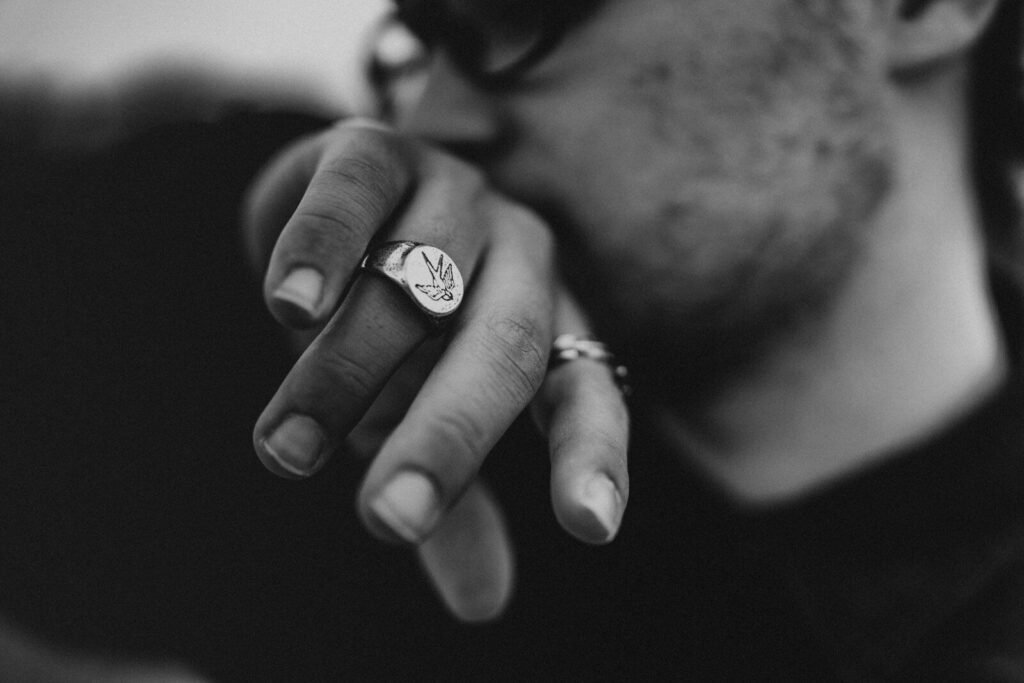
For much of modern history, the mainstream men’s jewelry market gave rings a narrow assignment. A man might wear a wedding band, a class ring, a family signet or, in some professions and organizations, a ring marking membership or achievement. Beyond those categories, decorative rings were often treated as unusual rather than ordinary parts of a man’s wardrobe. That convention shaped everything from jewelry-store displays to advertising, where men’s choices tended to cluster around plain bands in gold, silver or other restrained metals. The underlying assumption was that a man’s ring should communicate commitment, status or affiliation rather than aesthetic personality. That assumption has steadily weakened as men have become more comfortable treating jewelry as part of personal style. The ring, once one of the most standardized objects in a man’s wardrobe, is becoming one of the most individualized.
The change is visible in the way men think about what a ring is supposed to do. Instead of asking whether a particular design conforms to an established category, many buyers are asking whether it feels connected to their own tastes, relationships or experiences. That may mean choosing an unconventional metal, a dark finish, an engraved message, a substantial signet shape or a minimalist band with almost no ornamentation. The variety matters because it signals a broader shift in consumer behavior. Men increasingly expect products associated with identity to offer the same degree of choice they encounter in sneakers, watches, eyewear and tailored clothing. Jewelry is beginning to operate by the same logic. A ring can now function as a small but deliberate expression of character rather than merely a symbolic object assigned by tradition.
This evolution also reflects a broader loosening of the rules that once separated masculine and feminine approaches to adornment. Men do not necessarily have to embrace flamboyance to participate in that shift. In many cases, greater expression appears through subtle changes in proportion, texture, material or finish. A brushed titanium band communicates something different from polished yellow gold, even when both rings share the same basic shape. A wide black ring can feel architectural and modern, while a narrow silver band can look understated and personal. The new market accommodates those differences instead of treating one model as the default. As a result, men’s rings are becoming less about following a fixed convention and more about selecting the convention that feels appropriate to the person wearing it.
Personal Meaning Is Replacing One-Size-Fits-All Symbolism
The strongest force behind the change may be the growing expectation that jewelry should carry a personal story. Traditional rings have always been associated with meaning, particularly in marriage, inheritance, and institutional membership. What is different now is the range of meanings consumers are willing to assign to them. A ring may commemorate a relationship without being a wedding band, mark a personal milestone without being an award, or represent a private memory that is not obvious to anyone else. That flexibility gives men more reasons to wear rings and more freedom to choose designs outside conventional categories. The emotional value of the object increasingly comes from what the wearer believes it represents. In that sense, personalization is not simply an aesthetic development but a change in the social purpose of jewelry.
Jewelry sellers have responded to this shift by widening the range of rings built around individual preferences rather than a single traditional template. Relationship jewelry is becoming more varied, with couples able to choose pieces that communicate connection without requiring identical designs or conventional precious-metal bands. Materials, finishes, and proportions give shoppers more ways to align symbolic jewelry with how they dress and live. As these preferences broaden, specialized brands are creating more room for personal choice. Foreverings, for example, focuses on relationship jewelry and reflects this emphasis on material choice and style in its men’s rings in a variety of metals, including tungsten, titanium, and silver. These options let shoppers consider differences in weight, durability, finish, and appearance alongside meaning. The larger shift is toward relationship jewelry that reflects individual taste rather than overriding it.
The growing emphasis on meaning also changes the way consumers evaluate value. A ring does not have to be made from the most expensive precious metal to feel important. A relatively simple band can carry substantial emotional weight if it includes a private inscription, references a shared experience, or marks a difficult achievement. Conversely, an expensive ring may have little personal resonance if the design was chosen mainly because convention dictated it. This helps explain why contemporary buyers are often interested in the story behind a material or design rather than price alone. Value becomes a combination of durability, appearance, symbolism, and personal relevance. For men who historically had fewer opportunities to participate actively in jewelry selection, that broader definition of value makes the category considerably more engaging.
Materials Have Become Part of the Message
One reason men’s rings are becoming more expressive is that buyers now encounter a much wider vocabulary of materials. Gold and silver remain important, but they share attention with tungsten, titanium, stainless steel, ceramic, carbon fiber and mixed-material constructions. Each material creates a different visual impression and carries its own associations regarding weight, durability, color and modernity. Tungsten can feel dense and substantial, while titanium is often associated with lightness and technical performance. Silver can move easily between classic and contemporary styling depending on its finish and shape. These distinctions give consumers another layer through which to communicate taste. Material is no longer simply the substance from which a ring is manufactured; it has become part of the ring’s personality.
Surface treatments expand that vocabulary further. A highly polished band has a formal, reflective quality, while a brushed surface can appear quieter and more utilitarian. Hammered finishes introduce irregularity and make otherwise simple shapes feel handcrafted. Matte black coatings can create a sharper, more graphic appearance, especially when paired with geometric forms. Two-tone designs offer contrast without necessarily adding traditional ornamentation. Even small variations in edge treatment can alter how a ring appears on the hand. These choices matter because many men who prefer understated jewelry still want something distinctive enough to feel intentionally selected rather than generic.
Material innovation has also made it easier for rings to fit different lifestyles. A man who works frequently with his hands may care about different characteristics than someone choosing a ring primarily for formal occasions. Another buyer may prioritize low weight because he is unaccustomed to wearing jewelry, while someone else may prefer the physical presence of a heavier band. Color can be equally important, particularly for consumers trying to coordinate a ring with a watch, belt hardware, eyeglasses or other accessories. This practical decision-making does not reduce the ring’s expressive role. In fact, it often strengthens it because the final choice reflects both appearance and the realities of the wearer’s daily life. The result is jewelry that feels integrated into a person’s routine rather than added on solely for ceremony.
Design Choices Are Moving Beyond the Traditional Band
The classic wedding band remains one of the most recognizable forms in jewelry, but it is no longer the only reference point for men choosing rings. Signet rings have returned to broader visibility, often without the family crests or institutional symbols historically associated with them. Some contemporary versions use plain faces, engraved initials, geometric motifs or stones rather than heraldic imagery. Other designs borrow from industrial objects, architecture or minimalist product design. Wider bands, beveled edges, recessed channels and asymmetric details are becoming more familiar to shoppers looking for something beyond a smooth circle of metal. None of these elements must be dramatic on their own. Their significance lies in the fact that men can now choose among a far broader range of visual languages.
Proportion has become particularly important because even a simple ring can change character when its width, thickness or profile changes. A narrow band tends to appear restrained and discreet, while a broad band can become a prominent component of an outfit. Rounded edges may feel traditional and comfortable, whereas sharply defined edges can give a ring a more contemporary character. Flat profiles often appear architectural, particularly when combined with matte or brushed surfaces. Interior contours can also make larger rings more comfortable for people who wear them all day. These technical details increasingly form part of the purchasing conversation. Men who once might have selected a ring largely by metal and size are now evaluating silhouette, balance and finish much as they would when choosing a watch.
Stone-set rings are another area where older assumptions are changing. Diamonds and colored stones were once more narrowly associated with women’s jewelry in mainstream retail, but designers are increasingly incorporating them into men’s pieces in restrained and unconventional ways. A small inset stone can create visual interest without making the ring highly ornate. Dark stones can blend with black metals, while clear stones can introduce contrast against matte finishes. Traditional gemstones can also be used in signet-style or heritage-inspired designs without following the format of a conventional engagement ring. The growing acceptance of these options expands the expressive range of the category. More importantly, it allows men to decide how much ornamentation feels natural rather than treating ornament itself as outside the boundaries of masculine style.
Men Are Increasingly Buying Rings for Themselves
The growth of self-purchased jewelry is an important part of the market’s evolution because it changes the relationship between the buyer and the product. Historically, many men received significant rings rather than selecting them independently. Wedding bands were purchased in connection with marriage, class rings arrived through educational institutions and family rings were inherited or given as gifts. When the buyer is also the wearer, the decision process tends to become more personal. He may consider how the ring works with his existing wardrobe, whether it suits his hand and how often he expects to wear it. Those questions naturally encourage greater experimentation. The purchase becomes closer to choosing a watch or jacket than simply accepting a prescribed symbol.
Self-purchasing also expands the number of occasions that can justify buying a ring. A promotion, birthday, graduation, business milestone or major personal achievement can become a reason to choose a piece of jewelry. Some men buy rings because they want a visual marker of a particular period in their lives, even when the meaning is not meant to be understood by others. Others simply see jewelry as part of building a personal wardrobe. The absence of a formal occasion can itself be significant because it separates the category from ceremonial expectations. A ring can be purchased because the design feels right, not because a social convention requires it. That freedom encourages brands and designers to produce more varied collections for consumers who want to browse rather than fulfill a predetermined need.
The psychology of self-purchase also places greater importance on versatility. Someone buying a ring for himself may expect to wear it to work, on weekends, while traveling and at social events. That creates demand for designs that are distinctive without being difficult to integrate into different settings. Neutral metals, restrained textures and clean geometric shapes can appeal precisely because they work across multiple situations. At the same time, buyers with highly defined personal styles may choose bolder rings because they already know how the piece will fit into their wardrobe. Both approaches reflect a more active relationship with jewelry. Instead of viewing a ring as an isolated object, the wearer considers how it participates in the broader presentation of his identity.
Social Media and Celebrity Style Expanded the Visual Vocabulary
Changes in media consumption have also helped normalize a wider range of jewelry for men. Consumers now encounter style through a constant stream of photographs and videos rather than primarily through traditional advertising or department-store displays. Musicians, actors, athletes, designers and online creators regularly appear wearing rings in combinations that would once have seemed unconventional in mainstream menswear. A man might wear several rings at once, combine precious metals with inexpensive pieces or pair formal clothing with visibly contemporary jewelry. Repeated exposure matters because unfamiliar styling becomes less unusual when people see it frequently. The effect is not that every consumer imitates a celebrity or creator directly. Rather, the boundaries of what appears socially plausible become wider.
Digital media also allows highly specific styles to find audiences that would have been difficult to reach through conventional retail. Someone interested in minimalist industrial jewelry can quickly find designers working in that aesthetic. Another consumer can explore vintage signet rings, gothic motifs, Scandinavian minimalism, Western-inspired silver or highly polished statement pieces. These categories can coexist because online discovery does not require a retailer to appeal to every customer with the same collection. Niche aesthetics can develop strong followings even if they would occupy only a small portion of a traditional jewelry counter. That fragmentation gives consumers permission to develop more particular preferences. Men’s rings become less of a single category and more of a collection of overlapping style communities.
The visual nature of social platforms is especially well suited to rings because small design decisions can be communicated quickly in a photograph. Texture, shine, stone placement and proportion are immediately visible when a hand is shown holding a phone, steering wheel, coffee cup or bag. Those everyday images place jewelry in realistic contexts and help consumers imagine how a ring might fit into their own lives. They also reduce the distance between formal jewelry marketing and ordinary dressing. A ring does not need to appear in a velvet box to seem desirable. It can be presented as an object worn while working, traveling or meeting friends. That shift in imagery reinforces the idea that jewelry is part of daily personal style rather than something reserved for ceremonies and special occasions.
Customization Has Changed the Emotional Value Proposition
Customization gives buyers a direct way to transform a standard product into something specific to their own lives. Engraving remains the most familiar example because even a short inscription can change the significance of a ring. Names, dates, initials, coordinates, brief phrases and private references can turn an otherwise conventional band into a record of a relationship or event. The customization may be completely invisible to other people if it appears inside the ring. That privacy is often part of its appeal. Jewelry does not have to communicate its entire meaning publicly in order to be expressive. A personalized ring can operate simultaneously as an aesthetic object and as a private reminder.
More extensive forms of customization expand that principle. Buyers may select different metals, widths, finishes, stones or combinations of materials within the same general design. Some may want paired rings that share a visual element while remaining distinct in shape or scale. Others may prefer subtle coordination, such as matching engravings inside two very different bands. These options reflect a broader change in how relationships are represented through consumer products. Matching no longer necessarily means identical. Personalization allows two people to express connection while preserving individual preferences, which can make symbolic jewelry feel more authentic to both wearers.
Customization also helps explain why consumers can develop strong emotional attachments to relatively simple rings. A highly elaborate design is not required for an object to become irreplaceable. What matters is the connection between the physical piece and the memory or relationship associated with it. That connection can increase over time as the ring accumulates additional experiences through daily wear. Scratches, minor changes in finish and other signs of use may eventually become part of the object’s history rather than flaws to eliminate. In that sense, personalization does not end when the ring leaves the retailer. The wearer continues to personalize it simply by living with it.
The Future of Men’s Rings Is About Identity, Not Excess
The growing expressiveness of men’s rings should not be confused with a universal shift toward louder or more extravagant jewelry. For many consumers, personal expression means choosing something quieter but more deliberate. A plain band in an unexpected material can be just as individual as a heavily ornamented signet ring. What matters is the expansion of choice and the declining expectation that every man should make the same choice. Minimalism, maximalism, heritage styling and technical design can now exist comfortably within the same category. The market is becoming broader rather than moving toward one dominant aesthetic. That breadth is likely to be more durable than any single trend because it reflects a change in how consumers think about identity.
Men’s fashion has undergone similar changes in other categories. Sneakers became collectibles and design statements rather than purely functional footwear. Eyewear developed into an important expression of personality. Watches expanded beyond their practical purpose as smartphones made basic timekeeping less essential. Rings are following a comparable path, although their emotional and symbolic roles give them additional weight. A man can choose a ring because he likes its design while also attaching a private meaning to it. The combination of aesthetics and symbolism gives the category unusual flexibility. Few accessories can be simultaneously decorative, personal, relational and commemorative in such a compact form.
That flexibility is ultimately why men’s rings are becoming more personal. The category no longer depends on a single idea of masculinity, one accepted material or a limited set of occasions. Men can choose rings connected to marriage, partnership, family, accomplishment, style or no formal milestone at all. They can select pieces that are nearly invisible or deliberately prominent. They can follow traditional jewelry conventions, reinterpret them or disregard them altogether. As those choices multiply, the ring becomes less of a uniform symbol and more of a personal object whose meaning is determined by the wearer. The most significant change is therefore not that men are wearing different rings. It is that they increasingly expect the rings they wear to say something specific about who they are.