
A property investor in Hattiesburg spent weeks tracking down the owner of a vacant lot he wanted to buy. The county tax records showed an individual’s name. He found a phone number through a people search site, called it, and had a promising conversation with someone who said yes, they owned it, yes, they’d consider selling. They exchanged a few emails. Then he pulled the deed records before making a formal offer.
The person he’d been talking to hadn’t owned that lot for eleven months. It had already transferred to a family trust after a probate process. The phone number was real. The person was real. The ownership wasn’t.
Thirty minutes spent reviewing public records would have caught this before the first phone call. That’s not a story about bad luck – it’s a story about what happens when address and ownership verification gets skipped because the conversation felt like it was going well.
What You’re Actually Trying to Find Out
“Verifying an address” sounds like one task. In practice it’s usually three or four different questions wearing the same coat, and knowing which one you’re actually asking changes where you look first.
A landlord screening a rental applicant wants to know whether the address listed as a previous residence is real, whether the person actually lived there, and whether the landlord they’ve cited as a reference genuinely owns or owned that property. An investor prospecting for motivated sellers wants to know who currently owns a parcel, whether the tax record matches what they’ve been told, and – if the owner is an LLC – who actually sits behind that business name. A researcher doing skip tracing is working in the other direction entirely: starting from an address and trying to find a person connected to it.
Whether you’re verifying a rental application, researching property ownership, or tracing connections between people and addresses, an MS public records lookup can help bring together ownership records, address history, business filings, and other publicly available data before you rely on information from a single source.
Each of these tasks draws on the same underlying sources. The workflow just runs in a different direction depending on the question. Getting clear on your specific question before you start searching saves time and prevents the most common mistake in address research: treating the first answer that looks right as a confirmed fact when it’s really just a lead worth following up.
Mississippi’s Public Records: The Foundation
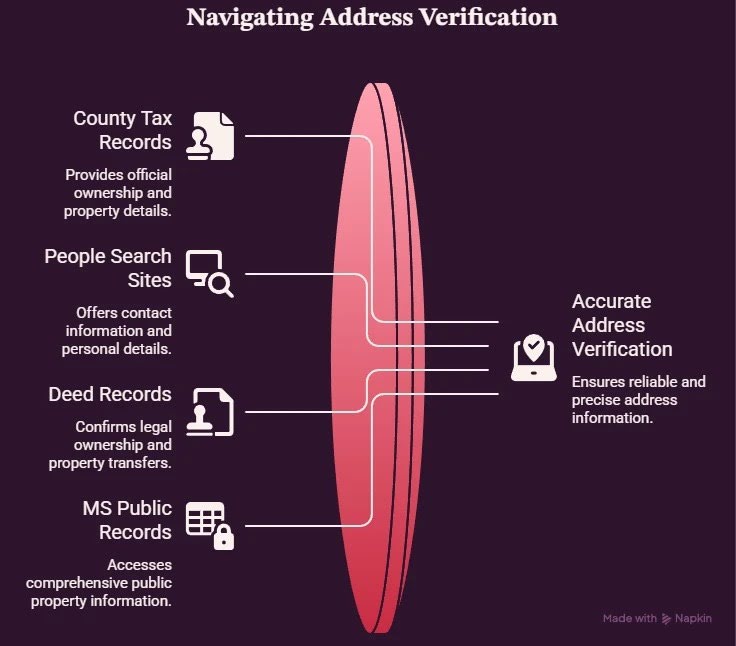
County-level records are the most reliable starting point for address verification in Mississippi, and they’re more accessible than most people expect. Every county in the state maintains property records through its tax assessor’s office, and the majority now have searchable online databases that are free to use.
A tax assessor’s record is often the single most useful document in the process. Search by address and you’ll typically get the parcel number, the assessed value, the name of the current owner of record, and the mailing address where tax bills are sent. That last detail matters more than it sounds. Owner-occupied properties usually send tax bills to the same address as the property itself. Investment properties often send them somewhere else entirely – an LLC registered address, a CPA’s office, a management company, or the owner’s home in a different county. That mailing address is frequently the only reliable contact point for an absentee owner, which is exactly why it matters to investors doing outreach.
Deed records sit with each county’s chancery clerk. These show not just who owns a property today but the full chain of title – every transfer, every mortgage, every ownership change, going back as far as the county’s digitised records reach. For an investor trying to understand a property’s history, deed records tell a story that the tax assessor’s snapshot doesn’t. A property that has changed hands three times in four years, or one where a trust or LLC appeared in the chain right after a death, carries a different set of implications than one that’s been in the same family since 1987.
The Mississippi Secretary of State’s office maintains a business entity database that becomes relevant whenever a property is owned through a company name. Search the LLC and you’ll find the registered agent, the registered address, and sometimes the organising documents that name the members. This is often how you get from “this parcel is owned by Magnolia Holdings LLC” to the actual individual you need to contact.
Finding the Right County
Mississippi has 82 counties, and the quality of online records access is genuinely uneven. Hinds, Harrison, DeSoto, and Jackson counties have well-developed search tools. Smaller rural counties may have limited online records, which sometimes means a phone call to the assessor’s office or an in-person visit to the chancery clerk. The Mississippi Department of Revenue maintains a statewide property tax lookup that covers most counties and is a good fallback when an individual county site is hard to navigate.
This variability catches people out. If an online search produces thin results for a rural county property, the absence of results usually reflects the database’s limitations, not the absence of records. The records almost certainly exist. They’re just sitting in a filing cabinet rather than a web interface.
People Search Tools: Useful, But Not Final
County records tell you about the property. People search databases try to tell you about the people – who has been associated with a given address, and for how long.
Platforms like Spokeo, BeenVerified, Whitepages, and similar services pull from public records, utility filings, and commercial data sources to build address histories. A reverse address lookup – searching by address rather than by name – typically returns a list of current and previous occupants, associated phone numbers, and sometimes household member associations. For a landlord checking whether an applicant’s claimed prior address actually has any record of them living there, this is genuinely useful. For an investor trying to find contact details for an owner who doesn’t appear in any directory, it’s often the only route to a phone number.
The important thing to understand about these tools is that they’re working with data that lags behind reality. Someone who moved six months ago may still appear at their old address in some databases. A recent property sale may not yet have propagated through all the commercial data sources even after the county tax record has updated. When a people search result conflicts with a county record, the county record is almost always more current.
What these tools do well is surface connections that aren’t obvious from a single database: a previous occupant you didn’t know to search for, a phone number associated with an owner’s name, a pattern of address history that raises a question worth asking. Treat the results as a set of leads, not a confirmed answer, and they’re genuinely valuable.
When the Results Don’t Match
Conflicting information across sources is the rule in address research, not the exception, and most of it is mundane. A tenant who moved three months ago still shows up at their old address in two databases because those databases refresh quarterly. A property that sold in January still shows the previous owner in a people search platform that pulls ownership data from a provider who’s running six months behind. These aren’t red flags – they’re just the normal friction of working with sources that update at different speeds.
What is worth paying attention to is a pattern of conflict rather than a single discrepancy. If a rental applicant’s claimed previous address shows no record of them in any database – not the tax record, not the people search results, not a reverse address lookup – that’s a conversation worth having with them directly. If a property owner’s name on a deed doesn’t match the person you’re talking to, and the Secretary of State’s records don’t connect them to the LLC in the chain of title, that’s a substantive discrepancy, not a database lag.
The mental model that works here is: one source disagreeing with others means a possible update delay. Multiple sources agreeing on something different from what you’ve been told means something that needs an explanation.
Getting From an Address to a Person
In practice, address verification in a real estate context almost always ends with the same question: how do I actually reach this person?
For owner-occupied properties, the tax assessor’s mailing address is usually the most reliable contact point – it’s where the owner has chosen to receive official correspondence about the property. For absentee owners, that mailing address may be an out-of-state home, a management office, or an LLC’s registered agent. In investor outreach, a physical letter sent to the tax record mailing address remains one of the most reliable ways to reach property owners who aren’t actively marketing themselves, precisely because it’s where they’ve directed official mail.
Phone numbers are trickier. Landline directories have thinned out as mobile numbers have taken over, and mobile numbers rarely appear in public databases. When a number does surface through a people search platform, it’s worth checking it against the owner’s name in at least one other source before using it for outreach – stale numbers attached to old records are common, and calling a number that used to belong to someone is a waste of time and occasionally an awkward conversation.
For investors doing any real volume of prospecting – working lists of absentee owners, vacant properties, or probate situations across multiple counties – list-building services that pull from tax records and people search data simultaneously tend to be more efficient than doing each search manually. The tradeoff is accuracy at the edges: these services are good at scale and occasionally imprecise on individual records, which is why the verification workflow still matters even when you’re working from a pulled list.
A Practical Verification Sequence
For a landlord screening an applicant or an investor researching a property, this sequence covers most situations without overcomplicating the process:
- Start with the county tax assessor database – confirm the property exists, identify the owner of record, and note the tax bill mailing address
- Pull the deed record from the chancery clerk to confirm the current ownership and check for recent transfers
- If the property is held in a business name, search the entity through the Mississippi Secretary of State’s database
- Run a reverse address lookup through one or two people search platforms to identify current and previous occupants
- Compare everything – consistent results across sources mean higher confidence; a pattern of conflict means follow up before proceeding
For a straightforward rental property or a standard prospecting search, this takes 20 to 30 minutes. For a transaction with significant money attached to it – an acquisition, a lease with a substantial deposit, anything where a mistake is expensive – a title company or real estate attorney can run a formal title search that goes deeper than any combination of online tools and produces a searchable, insured chain of title.
A Note on Responsible Research
Address verification is standard practice across landlord operations, real estate investment, and professional due diligence. Used properly, it produces better decisions and prevents the kind of expensive mistakes – the signed lease with a fraudulent rental history, the earnest money sent to someone who doesn’t own the property – that come from acting on unverified information.
The responsible framing is simple: use information for the legitimate purpose it was gathered for, within the legal framework that governs your specific use case. Tenant screening in Mississippi sits under fair housing law and the federal Fair Credit Reporting Act when commercial screening services are involved. Real estate investment research and due diligence operate differently. If the purpose is legitimate and the methods are legal, address verification is just professional practice – something to do properly, not something to be nervous about.