Arts
This photo zine “1437 Sokak” brings together images created over an extended period of living in Izmir

16 Dec
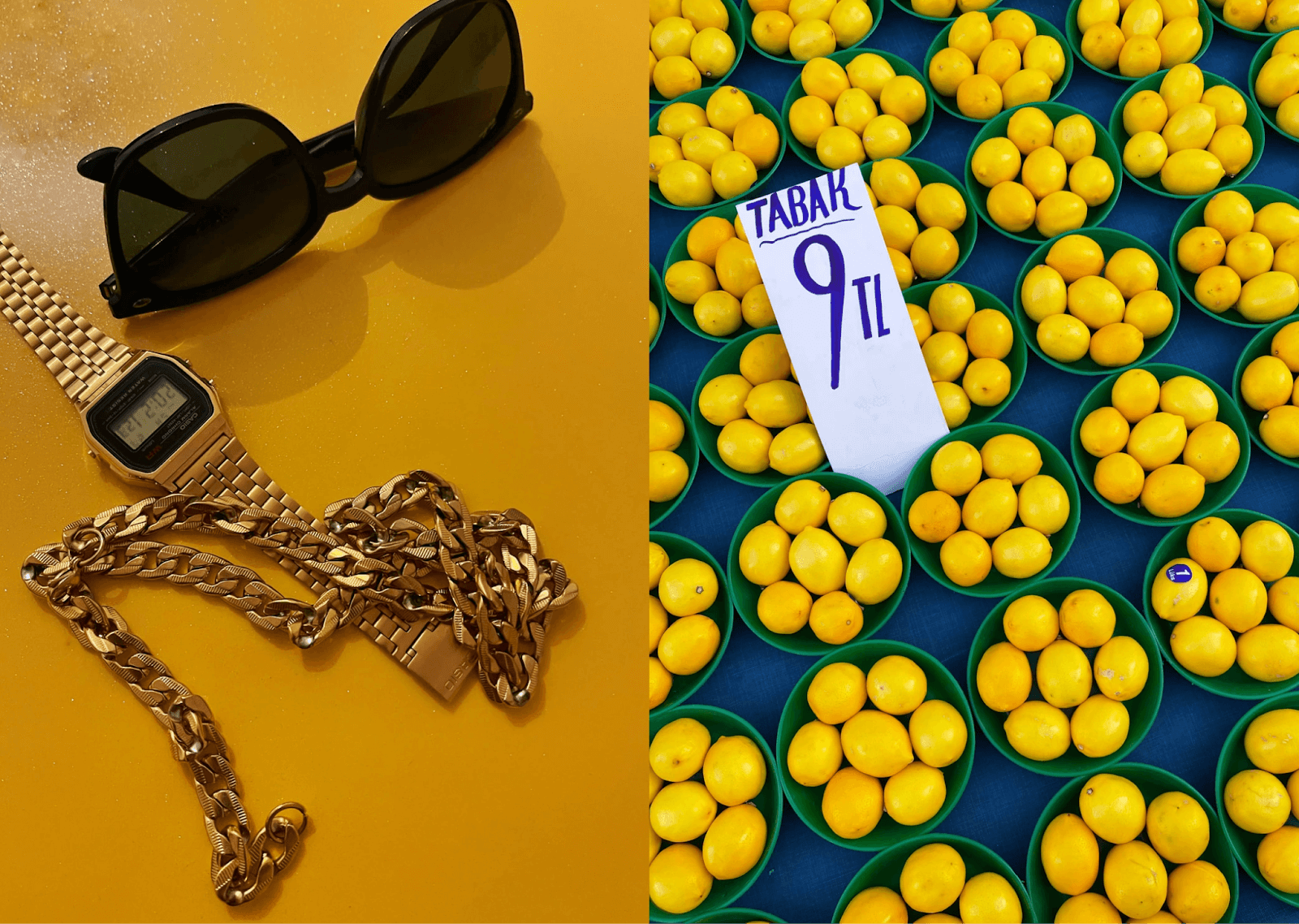
This photo zine “1437 Sokak” brings together images created over an extended period of living in Izmir. The work explores themes of belonging, routine, and quiet systems of control through repetition, color, and structure. Avoiding spectacle and direct commentary, the series captures the city in its present tense — not as a destination or event, but as a lived environment shaped by habits, rules, interruptions, and small moments of attention.
Frames of a City That Refuses to Perform
A photo zine doesn’t need a plot to carry a story. Sometimes it works like a pocket-sized archive: not of major events, but of the quiet systems that shape how you move, buy, wait, look, and belong. This series of photographs builds a portrait of a coastal city through its ordinary materials—fruit bowls, signage, uniforms, water, animals, storefronts—until the everyday stops feeling “small” and starts reading like a language.
What holds these images together isn’t a single character or a dramatic incident. It’s attention. The camera treats lemons and police lines with the same seriousness; a cat and a refrigerator full of bottled water share the same moral weight as architecture and sea. That refusal to rank subjects is the point. The zine asks you to slow down and notice how a place reveals itself when it’s not trying to impress you.
The city is made of traces
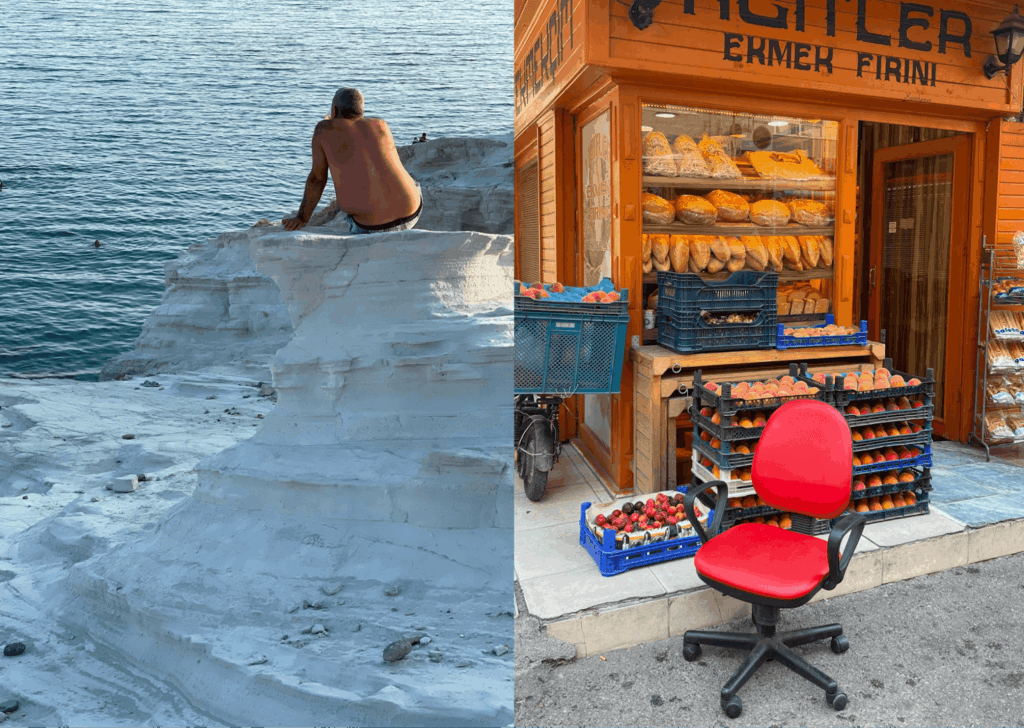
People appear, but often indirectly: a pair of shoes parked against a wall; a body-shaped absence suggested by an empty chair; the interior glow of a car stereo; the posture of someone leaning into a day at the market. Even when faces do show up, they rarely dominate the frame. Instead, humans are absorbed into the environment—one element among many in the urban ecosystem. This is an anti-heroic way of photographing. The city isn’t a backdrop for personal drama; it’s a living system that continues whether anyone performs a story in it or not. The photographs don’t beg for a narrative. They offer evidence.
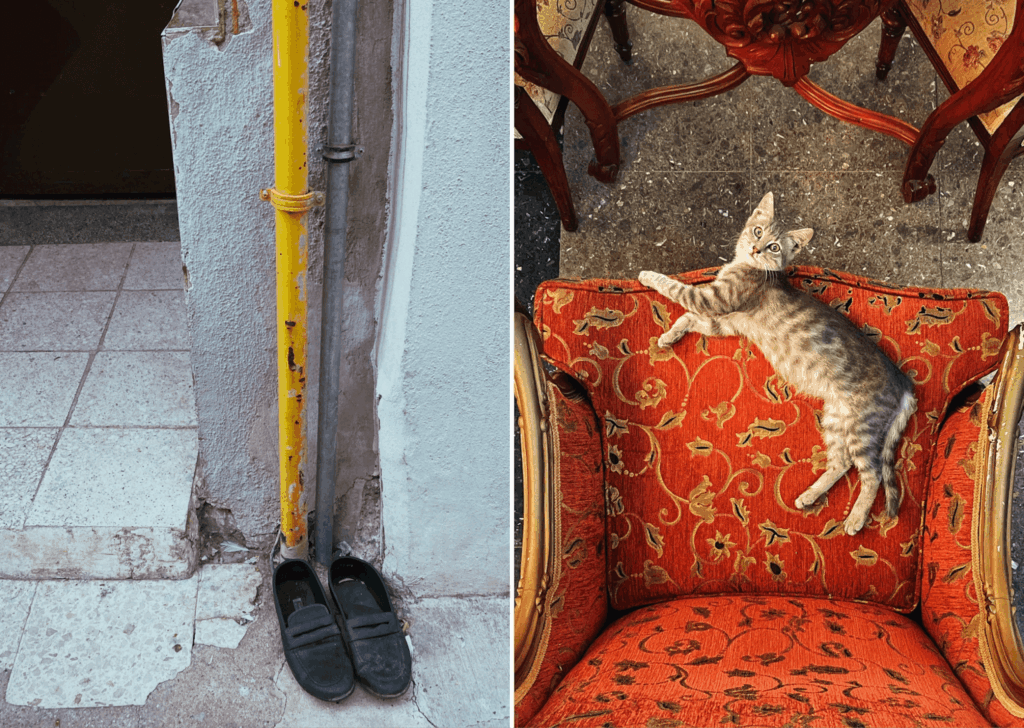
Repetition as a kind of time
One of the strongest formal gestures here is repetition: yellow against blue, red interrupting neutral stone, circles and grids repeating across stalls, labels, boxes, compartments. Lemons gathered in identical bowls. Bottled water stacked into a near-pattern. Numbered blocks and signs that slice the world into manageable units. Repetition turns into rhythm, and rhythm turns into a feeling of time—cyclical, market-time, street-time. Not the time of “a big day,” but the time of ordinary life: restocking, selling, waiting, passing through, returning.
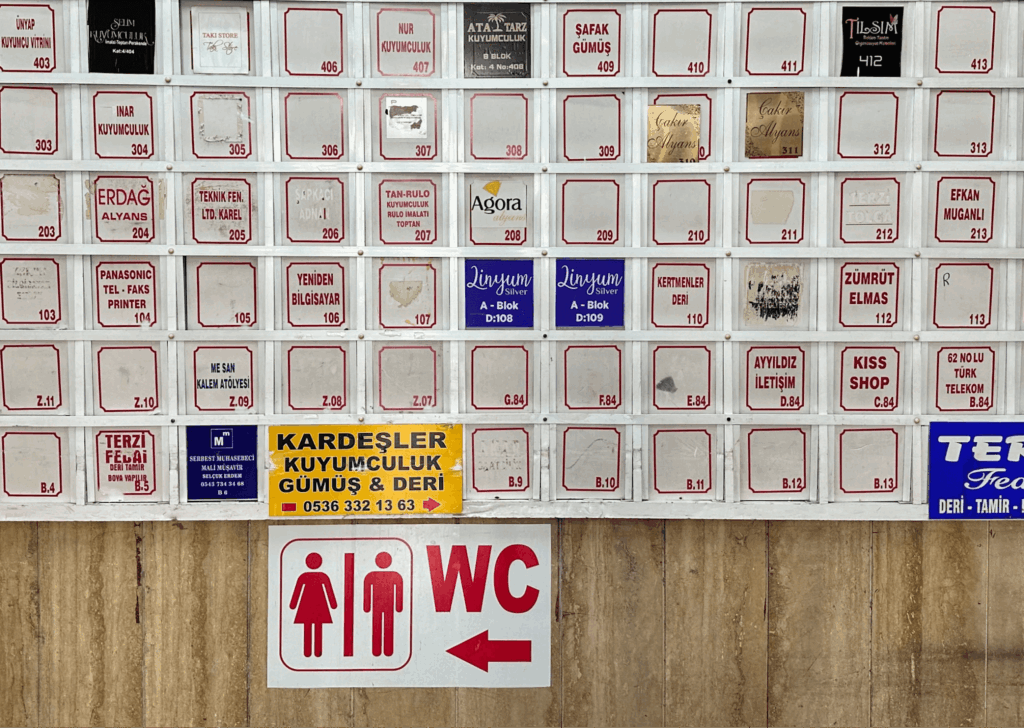
And then the living interrupts the grid. Seagulls scatter across the water, breaking the sense of order. A cat sleeps exactly where it isn’t supposed to. A market spills beyond its formal boundaries. A human body sits at the edge of white rock, facing the sea, reduced almost to a silhouette of weight and heat. These breaks matter. They make the city feel real: controlled, yes, but never fully controlled.
Quiet politics, embedded in the everyday
The political dimension of these images is subtle, which is why it hits harder. A line of police stands under decorative relief—authority framed as part of the normal architecture of public space. Nothing “happens.” That’s the point: power doesn’t always need an event to be present. Sometimes it’s simply there, waiting, occupying.
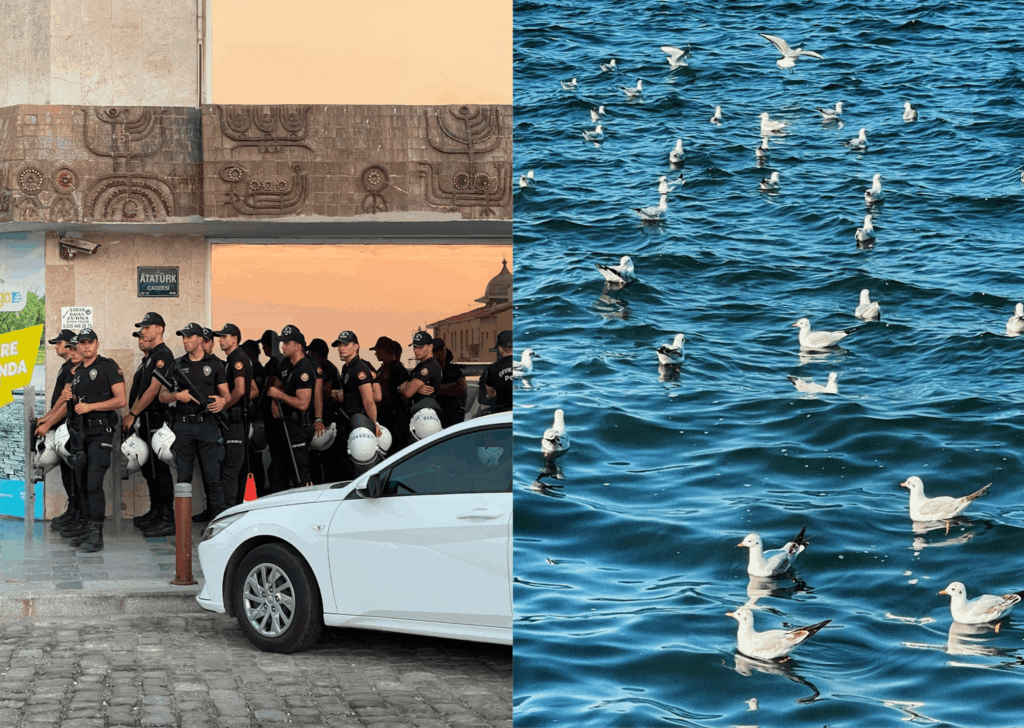
Language works similarly. “WC.” “Do not sit.” Shop names, numbers, prices. Signs don’t just communicate; they regulate bodies. They tell you where you can go, where you can rest, where you’re allowed to belong. Yet the photographs don’t moralize. They observe. They let the viewer feel the friction between instruction and life.
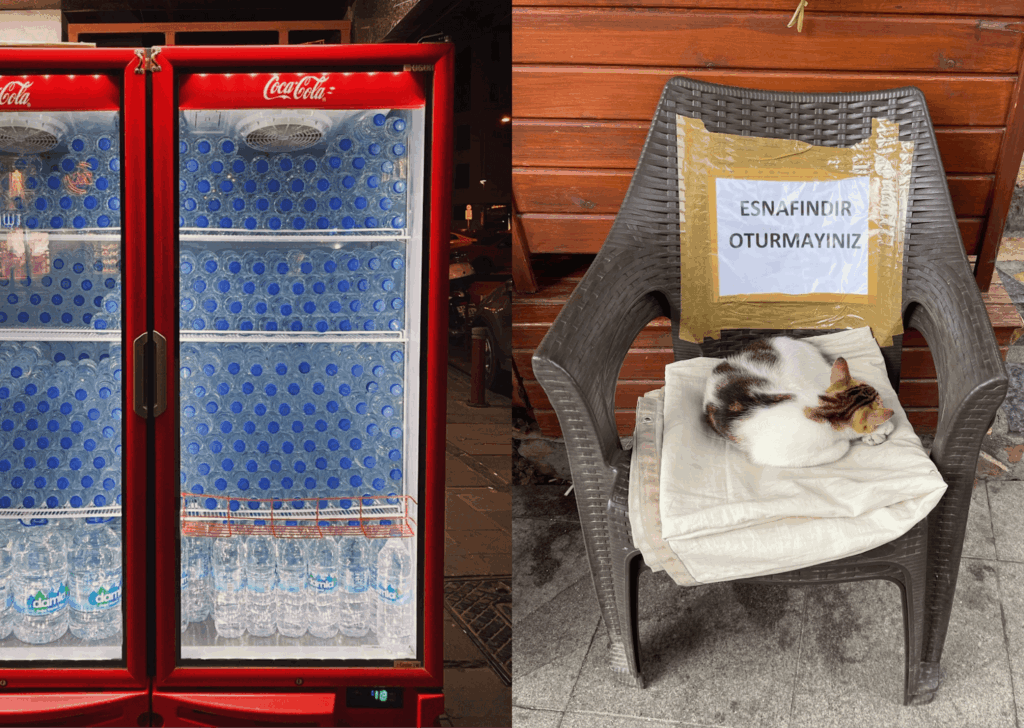
That friction is where the zine breathes: order versus improvisation, official rules versus everyday survival and humor.
Intimacy without confession
There’s no self-portrait here, and still the work feels personal. The intimacy comes from the camera’s position—close enough to care, distant enough to respect. The images don’t steal. They witness.
Food appears not as “aesthetic lifestyle content,” but as a small ritual of continuity. Markets are not exoticized; they are treated as infrastructure. Animals aren’t symbols; they’re residents. The zine avoids the easy romantic language of travel photography. Instead it insists on normality—the kind you only see when you live somewhere long enough to stop searching for highlights.
This is what makes the work feel like belonging rather than tourism.
An archive of the present tense
Taken together, these photographs function like an archive of the present tense. Not memory of an event, but a record of a state: the city as it repeats itself, the way it organizes and fails to organize, the way it holds people and objects in the same frame without turning either into decoration.
The zine suggests a particular kind of “home”: not ownership, not permanence, not a stable identity you can claim. More like a temporary contract with a place—made of repeated routes, habitual scenes, small recognitions. A city becomes familiar not because it gives you meaning, but because you learn its patterns and start noticing its exceptions.
In that sense, the photographs aren’t trying to solve the question of home. They’re showing what it looks like when you live inside the question.
About the artist
Vika Lisitsyna is a photographer and multidisciplinary artist based in Belgrade. Her practice focuses on everyday urban life, working with photography as a tool for observing how people, objects, and spaces coexist without hierarchy. Rather than constructing narratives, she builds visual archives from fragments of daily reality — markets, signage, animals, architecture, and fleeting human presence — treating the ordinary as a complete and meaningful subject in itself.